Week 3: Oregon State
Another Ah Yat goes to Corvallis. The gap is not 17.5 points.
Fool's gold
Another Ah Yat goes to Corvallis. The gap is not 17.5 points.
Sept. 7, 1996. A quarterback named Ah Yat went to Corvallis in Mick Dennehy's first season after Don Read's national championship and came home with a 35-14 win. That team went 14-0 into the title game before Randy Moss happened. Oregon State went 2-9. Every player on both rosters Saturday was born after that game, and one of them is Brian Ah Yat's son. Keali'i Ah Yat goes to Corvallis thirty years and twelve days after his father did, second in the Big Sky in passing yards, with his father's 560-yard single game from that same fall still sitting at the top of the same conference's record book.
The Griz are 2-0 in their last two visits to Corvallis. Yes, I am ignoring the twelve losses and two ties that came before. I've been very clear this is my column and I make the rules. The two were both in Corvallis: 1996, and Sept. 1, 1990, when Don Read's Griz won 22-15 at Parker Stadium under a Sunday Oregonian headline that read "Montana upends Beavers." Those two Oregon State teams went 1-10 and 2-9, and last year's team was 2-10. Oregon State has not beaten Montana since Nov. 20, 1982. Forty-four years.
I debated calling them the Ducks all column, just to needle them about the rival, but I am above that. I am also totally not doing it only because I already deployed the Duck bit against Drake in Week 2.
For the Griz to win
Their run: they give up on it by the second quarter. They tried it for three drives at Houston and put it away. Stymie the first two and it is Atkinson and Legree the rest of the night, which is the offense we planned on.
Their pass: nobody runs free. They will test us downfield and down the middle all night, and it is going to be a challenge. Legree is going to get his, and his is probably 190. Give him the 190. Give him nothing for a score. No points for yards.
Our run: our line opens it and Eli gets to the second level. Third-and-short is theirs to lose, 5 of 5 allowed to Houston and every one a run, and Montana is 8 of 9. Eli's share of the contested snaps is 32 percent, and Saturday should be his heaviest of the year. Handle the front and it is Eli against a secondary that has not yet looked up to it in the run game, with missed-tackle stats galore.
Our pass: our line holds, and we throw on second down. Eight pressures allowed against three FCS fronts, but #44 Hickle and #50 Haverland are a different test; Ah Yat has been sacked twice all year. Their co-DC coached Idaho last year and will deploy 7 and 8-man boxes on first down, so throw over it, then play action on second down, where they have allowed 9.64 a play and six completions of twenty or more on 28 throws. When their corners, #4, #28 and #19, are isolated, test them.
Jo Silver makes the ones that matter. Fifteen of fifteen on extra points and one field goal all year. A close game turns on a kick.
Coach Shephard said it first
JaMarcus Shephard, after the Texas Tech loss, on what his team is allowed to think about: "We're just worried about going into our next opponent and trying to compete at the highest level that we can against our next opponent. Anything beyond that is fool's gold, and our players should never even think about that."
Braden Atkinson threw for 413 yards against Texas Tech, the fourth 400-yard game of his young career. Jesse Legree caught 240 of them, second in program history to Mike Hass. Oregon State's explosiveness number, 1.64 on its successful plays, is higher than anything in my file this season. Two losses to ranked teams by 13 and 11. The Corvallis Gazette-Times: "The Beavers don't look like the last-place team in the Pac-12 Conference." The line is Oregon State by 17.5 at Sports Bet Montana and at the national consensus, up four to eight points from where it opened, with 92 percent of the spread money on the Beavers. I am fading the public, baby.
A reason for optimism for our defense: Oregon State has stayed on schedule on 35.4 percent of its snaps this year, and against the same Texas Tech defense that allowed 27.9 percent to FCS Abilene Christian, the Beavers managed 29.6. Their drives start at their own 22.9 and produce 4.00 points a trip once they cross the 40. The run game gained 1.8 yards a carry in the box score and 3.50 with the sacks pulled back out, and no running back on the roster has a run longer than ten yards. Bill Connelly, whose five factors this column runs on, has shown that efficiency carries from one half of a season to the next and explosiveness barely does. A 413-yard game is a thing that happened. What matters is what those yards result in.
SP+ has Oregon State 85th of 139 FBS teams. One Pac-12 team is in the top 70. On Connelly's all-divisions sheet, four FCS teams rank above half the league, and two of them, Montana State and South Dakota State, rank above Oregon State; Montana sits 115th on the same sheet, which is why the SP+ number is 6.3 and not zero. SP+ is the only one of the three that filters garbage time and the one built for cross-division matchups, and it predicts the closest score, so I am leaning on it. Montana is not walking into the old Pac-12. It is walking into a reconstituted Mountain West wearing an inherited name, and Oregon State is a middling member of it.
One more on the ratings, and I know it is a homer argument, so I will make it fast. SP+ had these two 4.7 points apart in August. After two weeks they were 0.4 apart, a pick 'em. Then we played a fourth quarter with the twos in against Utah Tech and they played a fourth quarter within eleven of Texas Tech, and the gap is 3.8 again, 6.3 with the home field. Those games happened, but there could be more to the story. A homer argument, but I'm a homer.
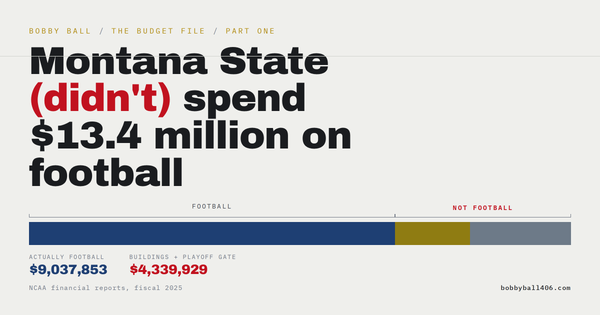
At the same time, Oregon State reported $23.8 million of football spending last year, much more than our $8.7 million. This is definitely a better-resourced program. And no, Bobcat fans, I won't be auditing the Beavers' books; they haven't bragged about them or compared them to the Griz. You are free to do so yourself. Here's the template.
Their quarterback is from FCS Mercer. Their tight end is from FCS Utah Tech and caught seven passes against Texas Tech the same Saturday we beat Utah Tech 35-14. A starting linebacker came from FCS Idaho, a starting defensive tackle from FCS Portland State, the co-defensive coordinator from Idaho. Twelve of their twenty portal arrivals came from FCS programs. Their podcasts spent the week explaining that Eli Gillman is an FCS back who couldn't move up. Who's the FCS team here? We shall find out.
Five factors, two schedules
Success rate is just the share of snaps that kept you on schedule. Explosive rate is runs of fifteen or more and completions of twenty or more, over every snap. Finishing drives is points per trip once you cross the opponent's 40. Field position is where the drive starts. Turnovers are turnovers: Montana has taken five and given away two, Oregon State has taken three and given away one, and Atkinson's one interception in 99 attempts came with at least three dropped against Houston. Connelly charts how often the team that wins each category wins the game, so I look at how each team has performed in each one coming in.
The offensive finishing numbers come off the official drive charts and the defensive ones off ESPN's, so read that row as a shape. Montana's defensive rates have the fourth quarters with the twos in cut out. Our numbers came against Southern Utah, Drake and Utah Tech. Theirs came against Houston and Texas Tech, the 31st and 15th teams in FBS. The numbers are directional. They tell you where each team is strong and where it is weak but are not absolute given a huge disparity between our and their opponent quality. We need these to hold up.
Oregon State wins one bar on the chart, offensive explosive rate, 8.3 to 7.3.
Read the chart the way Connelly weights it. Efficiency and finishing carry from one half of a season to the next, field position too, and Montana owns all three against three relatively weak opponents who could not take them away. Explosiveness barely carries at all, and it is the only row in orange. That is the game in one picture. If Legree runs past a safety twice, the 86 percent belongs to Oregon State and the rest of the chart goes quiet. If he doesn't, their drives keep starting at the 23 and ours keep starting a first down closer, and the numbers that were true coming into the game stay true in the fourth quarter. The schedules are too far apart for any of that to be a prediction. It is a shape, and the shape is maroon. I will point out once more that Oregon State had essentially the same success rate against Texas Tech as FCS Abilene Christian did, who is 0-3 this year and favored by half a point at 0-3 Idaho this week.
One freshman receiver, an FCS quarterback, and no run game
Third-and-2 at the Houston 49, late first quarter. Cornell Hatcher Jr. rushed for one yard, because a tight end missed his block. Fourth-and-1, Atkinson sneaks for nothing, turnover on downs. That was the run game's big night, a drive where they ran on six of seven snaps, and it ended at the Houston 48. For the season the Beavs are 106 dropbacks against 38 true rushing attempts, five rushing first downs against 33 passing, and five running backs who have combined for 96 yards on 31 carries with a long of ten. The front of the line gets blown off the ball, the tight ends do not care to block, and by the second half in Houston they stopped pretending to try.
Here is what I will be watching in the first quarter: whether the Beavers come out and try to establish the run. I expect they will. It has been a point of discussion for them this week, and they tried it at Houston, eleven runs on the first sixteen snaps before they quit. If the Griz stymie it on the first couple of drives, expect them to abandon it again. If it works, we are in uncharted territory, and an Oregon State offense that can run will be very difficult for us to slow down. We have to ease them into their one-dimensional passing game early.
Third in the country in passing yards, last in rushing, tied 107th in scoring. You don't get any points for yards, and here's another program built to prove it.
Wide open formations, throwing all the time
Four or five wide on nearly every snap, quads, empty, 11 personnel that plays like 10, because #80 Eric Olsen and #8 DeCorion Temple are glorified receivers playing tight end, and often split out as much as they line up in-line. I did not find them to be good blockers; they were lazy on the wham and a liability on everything else. A tell worth memorizing is #82 Gabe Milbourn. He is a blocking tight end, much better at it than the other two, he was not targeted once at Houston, and he barely plays outside of running plays. When #82 is in, it is probably a run.
They play no huddle but don't go fast. They check at the line constantly, first cadence and then a new play off the alignment. ESPN's play-by-play tags 71 of their 77 snaps at Houston as no-huddle, and the stopwatch says 27 seconds between snaps to Houston's 30, while a real tempo team runs 20 to 22. They are not fast. They just throw a lot.
Braden Atkinson is 19, a Mercer transfer, the reigning Jerry Rice Award winner as the FCS freshman of the year, and the least mobile quarterback we have faced, with far less pocket movement than Southern Utah's or Drake's guy. What he does do is let it rip. The offense pushes the ball down the middle and to the deep outs, and he will throw into a window that is tight and complete it, and also throw into a window that is not there. Houston dropped at least three that hit them in the hands. His line reads 60 of 99 for 789, three touchdowns and one interception, and the one is the misleading number on the sheet. At Mercer last fall he threw 34 touchdowns and seven interceptions in an FCS Southern Conference regular season. Then Mercer went to South Dakota in the playoffs, lost 47-0, and Atkinson threw four picks on 18 of 39 for 148. Montana beat that same South Dakota team 52-22 the next week. Seven in ten conference games, four in the biggest game of the year.
Jesse Legree, receiver #12, is a true freshman from Baltimore, 5-10 and 172, and he jumps off the screen, he eats up the cushion before the corner has finished thinking about it. He is fast and has shown great hands, and I am concerned about him. Actually, he is very fast. He will be a handful. Thirteen catches for 376 yards, 28.9 a catch, a long of 75, all three of Atkinson's touchdown passes, ten of the thirteen for fifteen yards or more. Expected points is the running scoreboard nobody prints: every spot on the field on every down is either adding or subtracting from your total, and a play is worth however much it moved that number. Nineteen snaps targeting Legree are worth +31.2 expected points this season. The other 125 snaps have been worth +2.4. Ninety-three percent of the offense is one true freshman, and the two receivers behind him are catching 41 percent of what comes their way.
Besides the TE #80 Olsen, Cynai Thomas, #16, is the other one to know, a 6-3 true freshman with Ole Miss, Auburn and Oregon offers, two catches on the year, one of them for 28 yards on third-and-15 from their own 6.
Good up front, soft behind it
Five sacks in two games, one at Houston and four against Texas Tech, and the count is the least interesting thing about this front. The line stems before the snap and runs pressure games (twists etc.) on passing downs and compresses the pocket with four consistently. #44 Takari Hickle has at least half a tackle for loss in six straight games, and PFN charts him with seven pressures on 101 snaps. Both starting tackles are charted at zero.
Ten pressures from six players, all of it against two Big 12 lines. Houston's Conner Weigman got the ball out and they touched him once in 32 dropbacks, at 10.03 net yards a dropback. Texas Tech's Will Hammond held it, and they got him four times and held him to 4.10 net yards a dropback through three quarters. The variable is the quarterback. Ah Yat has been sacked twice all year. And he will need to be decisive on Saturday.
Against the run OSU's d-line is a different group. Yielding 414 yards on 81 true carries, 5.11 a pop, with opponents choosing to run on 55.5 percent of their snaps. Houston ran for 5.90 a carry and 236 on 40, and on Houston's runs a defensive back was the first tackler eight times at 9.38 a carry, against 3.69 when the front seven got there first. Stuff rate is the share of carries stopped at or behind the line, and theirs is 14.8 percent. Colonel Mustard's group is at 25.3. They play heavy boxes on first down, which is what a front does when it would rather guess when it doesn't think it can hold.
The secondary is a weakness
#4 TJ Crandall, a transfer by way of Colorado State and West Virginia, has started both games at one spot, and allowed a 77.8 percent catch rate and a 109.3 passer rating by PFN's count, has zero pass breakups and misses 20% of his tackles. #19 Trey Glasper started opposite Crandall at Houston and true freshman #28 Blake Thompson against Texas Tech, and five corners have played in two games. Two separate problems, and we should attack both. In coverage, no corner plays well on the line, and PFN's charting on Crandall and Thompson reads fifteen targets, eleven catches, zero breakups, zero interceptions. In run support, they showed me little interest or ability in tackling, and that was part of the run defense story. #36 Drake Vickers, the strong safety, misses better than a quarter of his tackles, missed some run fits and allows a 158.3 passer rating, all of which showed up when I was watching. So the job for our line is to get Eli to the second level, where he can do what he does against a secondary that has not looked up to the task in the run game yet. It is a real problem for them if we handle the front.
Sailasa Vadrawale III, #8, is a good player, definitely their strongest in the secondary. PFN gave him their highest grade in their secondary, 82.0, and my eyes backed it up. Jarrel Comer, #18, is a 6-4 linebacker who ballhawks: he picked off Weigman at the Oregon State 15 in the third quarter and lost it to an interference flag on his own safety. Be careful throwing in his zone. Coach MacIntyre, unprompted this week: "We're gonna have to tackle well in space this week, and be able to get their running backs down." Yes, they are.
They have also struggled with tight ends. Houston's Patrick Overmyer, 6-5 and 240, caught six for 84, a 30-yarder on first down and a 25-yarder on second-and-15, a few of them off play action. Texas Tech's Matt Ludwig, the Billings West product they call Moose, a 6-4, 255-pound freshman, caught three for 30, the last one the eight-yard touchdown on third-and-7 with 1:03 left that put the game away. (Family you choose is arms wide open if you get homesick, Moose.) Both are NFL prospects. Our tight ends, Mariano Birdno, Titus Rohrer and Reese Brooks, haven't seen heavy use yet this year: seven catches for 69, two for 11 and one for 7. They do not need to make a ton of plays Saturday. They need to make some key ones.
The Griz must pass more on first down to rush more on third
Cort Dennison is the co-defensive coordinator for the Beavers, and he ran Idaho's defense in Missoula last September when we beat the Vandals 41-30 in a game which was not as close as it looks. He is the only man on this staff who has coached against Montana. What he saw that night: 42 carries for 209 yards, a pass on 25.8 percent of first downs, 8.76 net yards a dropback. What he has on film from this year is the same sheet. He will load the box on first down and he will be right, until we make him wrong.
When Houston stayed on schedule, Oregon State could do nothing with them. When Houston fell behind the sticks, Oregon State looked like a P4 defense. Montana succeeds on 60.4 percent of standard downs against an FCS median of 46.6%, and on passing downs (longer yardage after an unsuccessful play) only 22.4%, seven points under the median and twelve under last year's Griz. Forty-eight snaps this season, a quarter of the offense, have come from behind the chains, and we have succeeded only 18.8 percent of the time.
Running out of a passing down against them is 2 for 22 this season, one of nine for Houston and one of thirteen for Texas Tech. Third-and-short is where they have been worst, five for five against Houston, all of them runs, and Montana is 8 of 9 on the same down. So the plan for Saturday is the one I have been asking for since Sunday: pass on first to rush on third.
We have run on 48.9 percent of first downs, and Dennison has all three games of film. The first-down pass is higher mean and higher variance: 10.11 a play against 7.16 at the same success rate, with 34.8 percent of the dropbacks gaining nothing or losing ground against 20.0 percent of the runs. Against a loaded box on first down, that variance is the point. Houston's two shots that broke the game open came on second-and-10 and second-and-8. Play action needs a run somebody believes in, especially on second down. Across both games, second-down throws against the Beavs have gone for 9.64 a play with six completions of twenty or more on 28 plays, and on second-and-7 or longer it is 10.37 a play against 2.64 for a run into the same spot. That is the down to throw on, and it is the down we have thrown worst on: Montana is 4.56 a play and 29.6 percent success on second-down throws this year, against 4.81 and 50 percent running it. The play data carries no play-action tag, so that part is my eyes, and Houston's tight end ate off it.
The Eli Gillman showcase
Lost in the "Eli needs more touches" argument is how little he has been on the field. Forty-six plays against Southern Utah, then three quarters of work in each of the next two games. His raw touch share is 27.7 percent. On the snaps where our starters were in and the game was still a game, it is 32.0, and I expect his heaviest share of the year this weekend. Forty-nine carries for 328 yards, 6.69 a carry, and PFN grades him 98.5, first among every running back in FCS. Two records are live. He needs 65 yards to tie Yohance Humphery's 4,070 and 66 to pass it, and his 56 rushing touchdowns are tied with Charles Roberts for the Big Sky record, so the next one is his alone. An FCS back who couldn't move up was the refrain from corners of the Beaver-verse this week. I sure hope he shows them.
Saturday is also Eli's weekend to showcase himself, for the Griz and for himself. Colter Nuanez made the point on his radio show this week: a big showing against a Pac-12 front, on a national broadcast, probably gets him drafted, or drafted higher than he would have been otherwise. The scouts who are skeptical of the FCS tape will be watching this one.
The new Griz o-line looks like the real deal
Heading into the season, 247Sports called this offensive line Montana's primary weakness because it "returns zero starters up front." Well, this line has so far been one of our strengths.
Two sacks allowed on 108 dropbacks, 1.9 percent, below the fifth percentile of FCS. Eight pressures allowed all season. Three linemen ranked in single digits. Saturday we find out.
Keali'i Ah Yat has been playing three quarters too, out at 11:33 against Drake and 9:02 against Utah Tech, and he is 67 of 103 for 793 yards, 7.7 an attempt, five touchdowns and one interception, second in the conference in yards behind Idaho State's Jordan Cooke at 808. The people questioning him are overlooking the same missing quarters they overlook for Eli. Ah Yat has been playing supremely efficient football and I expect that to continue.
We need to make some field goals
Jo Silver is 1 of 4 on field goals. Three of the four were from 50 or longer, two of them end-of-half heaves, the 55 against Utah Tech off the crossbar, and the one from inside 40 was blocked rather than missed. Field goals have been a problem all year that cannot be a problem Saturday. Silver was born in Indonesia, has lived in six countries and moved ten times, walked on before spring camp in 2024, and got a partial scholarship this offseason, all of it from Frank Gogola's feature at 406 MT Sports this week. His father worked at the CIA. The agency has always developed its assets slowly. This week we need Jo ready to go on mission.
Give up the yards, not the touchdown
The first long ball to Legree at Houston was a total coverage bust. Houston let receivers loose over the deep middle at times, got lucky on a few incompletions, and the 71-yard touchdown came out of coverage that had already broken. That is the whole assignment for Colonel Mustard and the Mustardettes: our safeties and linebackers cannot get exposed in space. As long as they are not long touchdowns, our defense gets a chance to do what it has done all year in the fringe and the red zone. Montana has allowed 2.13 points a trip inside its 40, 34 points on 16 trips. That is very good. Oregon State's offense produces 4.00 a trip.
The published defensive numbers are 42.6 percent success allowed and 4.3 percent explosive. Cut the fourth quarters where the twos were in, up 35-3 on Drake and 21-0 on Utah Tech, and it is 39.2 and 3.9, with our starters allowing 1.3 expected points across 204 snaps and the backups 12.9 across 31. Our starters have looked much better than the general consensus has been online. Because, and you will get tired of me saying it, you don't get points for yards.
Here is where we steal a concept. Third-and-7 at 13:04 of the first quarter in Houston: six-man front, double-mug look, backers drop out, a nickel comes off the edge, and the Oregon State line misses it in the protection. Javion White, minus 11, and the field goal on their second drive because of the sack. Montana's sack rate is 3.7 percent, five in 136 dropbacks, under the FCS median of 5.7 and a whisker above the fifth percentile at 3.3. Sacks are not the stat, and against a quarterback who does not move they do not have to be. Show the double-mug, bring four, and find out whether their line can count. I hope we show it early.
Atkinson will give us interception chances. Houston dropped at least three. South Dakota took four. Montana has one interception in three games after thirteen in twelve last year, and this is the week for that number to move, as long as nobody is running free behind it.
The honest problem is our defensive front, where we have serious depth issues right now. Bobby 3.0 after Utah Tech: "We are rotating so many guys on the defensive front, so we are continuing to grow in that area." A team that throws 73.6 percent of the time keeps the sub package on the field and the rotation short. When #82 is out there, the Mustardettes can stay big and play the run. When he is not, it is dime all night.
One thing in our d-line's favor: Pac-12 officials. Outside the grasp of the Big Sky's zebras, we will see how much a different crew allows them to be inside the grasp of the Beavers. It cannot possibly be more than it was last week against Utah Tech.
The case for the Beavers
Four sacks against Texas Tech. The line stems and games its way to pressure on passing downs, and our line has held up against Southern Utah, Drake and Utah Tech. Only 8 pressures allowed is a real number against those three. It is not yet a number against this front four.
Legree averages 28.9 a catch. Atkinson averages 6.99 net yards a dropback against Big 12 defenses. Our defense, with the backups removed, has allowed 4.93 net yards a dropback, 604 yards with two touchdowns and three completions of twenty or more on 117 dropbacks, and that is not counting the fourth quarter against Utah Tech or the last eleven minutes against Drake, which went against some young corners we are bringing along for later in the year. However, if one of our corners or safeties is late once against Legree it is 75 yards. I'm expecting that will happen once or twice, if it's all night long, it won't be good. It is 9 p.m. on the road, our first road game, and they have covered twice. DeCorion Temple, at Monday's presser: "Montana is a team that you don't want to take lightly. ... We can't do that. If we go in there Saturday sleepy-eyed and just to try to breeze through the game, they will win. And we know that."
The word for them is battle-tested, and I can see it both ways. They've played eight quarters against Big 12 lines and been beat up doing it. Our starters sat the fourth quarters the past two weeks. Watching it, the Houston game did not feel anywhere near as close as the 33-20 margin. Houston turned it over on the way to scores, jumped offside, played the second half in a downpour and sleepwalked through most of it, and none of that was anything Oregon State was doing to them.
Somebody is going to be the fresher team as the 4th quarter rolls around sometime around 11:30pm at the Mo Club. I hope it is not the one that spent last Saturday getting hit by Texas Tech.
Bobby Alert, transitive edition
The siren stays off. Forty-nine names on the staff directory, 108 on the roster, and not one Bobby, Bob or Robert, the first empty sweep of the year. So we go transitive. JaMarcus Shephard once worked under Bobby Petrino, who is from Helena. Mike MacIntyre lettered at Georgia Tech under Bobby Ross. A graduate assistant played at UC Davis under Bob Biggs. And ten months ago the man running the program was named Robb Akey, and Robb is Bob if you squint, meaning there may still be some Bob residue in the building. Level zero, with residue detected. Advantage Griz.
The Name Scout
The roster. Exodus Ayers. Clive Pond. Marquis Raspberry. Tiger Black. Jhae Drummer. Tug Sanford, the only pull in their run game. Kourdey Glass. Harlem Howard. Sailasa Vadrawale III. Drake Vickers, a Drake, two weeks after Drake. Four Jakes. Seventeen players with a given name out of scripture, and thirty jersey numbers worn by two players each, which seems like an ungodly amount. Every number from 0 through 8 is doubled. #12 is Legree on offense and Goodman at the nickel. #8 is Temple at tight end and Vadrawale at safety. When the broadcast tells you which number made the play, ask which one.
The coaches. A coach name scout special edition. Boone Brackett, Director of College Scouting. Reef Diego, Director of Football Visual Brand, who also coaches the surf team. Cort Dennison, previously discussed. Ricky Brumfield, special teams coordinator, and you have to be careful with a coach named Ricky. I won't elaborate. Brandon MacTrinder, assistant athletic trainer, has me on alert.
The Brother Index
The Goodman lead is dead. Gyriece Goodman is from De Pere, Wisconsin, by way of Garden City Community College, Styles is from Austin by way of Air Force Prep, and nothing connects them but the name and my hopes. Michael and Peter Langi, both freshmen on OSU's offensive line, hometowns nine miles apart in the Bay Area, and neither bio mentions the other: suspected. Joe Seumalo coaches Oregon State's edges and Zeke Seumalo plays nose for us, and nobody has confirmed a thing, which is how a cross-roster entry stays open. Week 3 Brother Index: Oregon State 0 confirmed, 1 suspected. Griz 4 confirmed and 3 suspected, plus cross-roster question marks. Advantage Griz.
Portal target of the week
Jacob Anderson, #74, offensive line, 6-6 and 300, Billings West. The only Montanan on Oregon State's roster and the No. 2 recruit out of Montana in the class of 2023, with Montana and Montana State both offering when he left. He redshirted in 2023, played six games in 2024, and played six in 2025, with one start. This year he did not get on the field at Houston and played a bit against Texas Tech. His line on the way out of Montana: "I thought I could play bigger football. That's the majority of it." He is now on a roster with a quarterback from Mercer, a tight end from Utah Tech, a defensive tackle from Portland State and a linebacker from Idaho. Here's the deal, Jacob: if we win, you come home with us.
Last Call
I believe the Griz can win this game, and I believe the gap between the teams is not wide. Certainly not 17.5 points. We don't need a better Griz team to show up in Corvallis than the one we have seen so far, but we do need a more efficient and consistent one. My prediction: Oregon State throws for 375 and Legree gets his, mostly in the open field. The Mustardettes give up the yards between the 40s and get stingy in the fringe, Atkinson puts two in our hands and we hold onto them. We bow up against their flailing run game, when it matters. We throw on first down early, play action on second down, both more than Dennison expects, and once the safeties start cheating, Eli runs through a front that gets sealed and runs over corners that would rather not tackle him. The (official, but not actual) rush record is his, passing Yohance, before halftime and the Big Sky rush touchdown record is in the rearview mirror by the end of the game. Jo Silver makes two kicks that matter. DeCorion Temple, the tight end who was lazy on the wham block, is right that the Beavs cannot go in sleepy-eyed, and they won't, and it won't matter. To be transparent, if the Griz were headed to Bloomington to face off with Indiana, you can bet this column would still be finding a way for a squeal of the pig to float on the air.
Good Guys 37, Oregon State 31.
Go Griz.