Montana State didn't spend $13.4 million on football
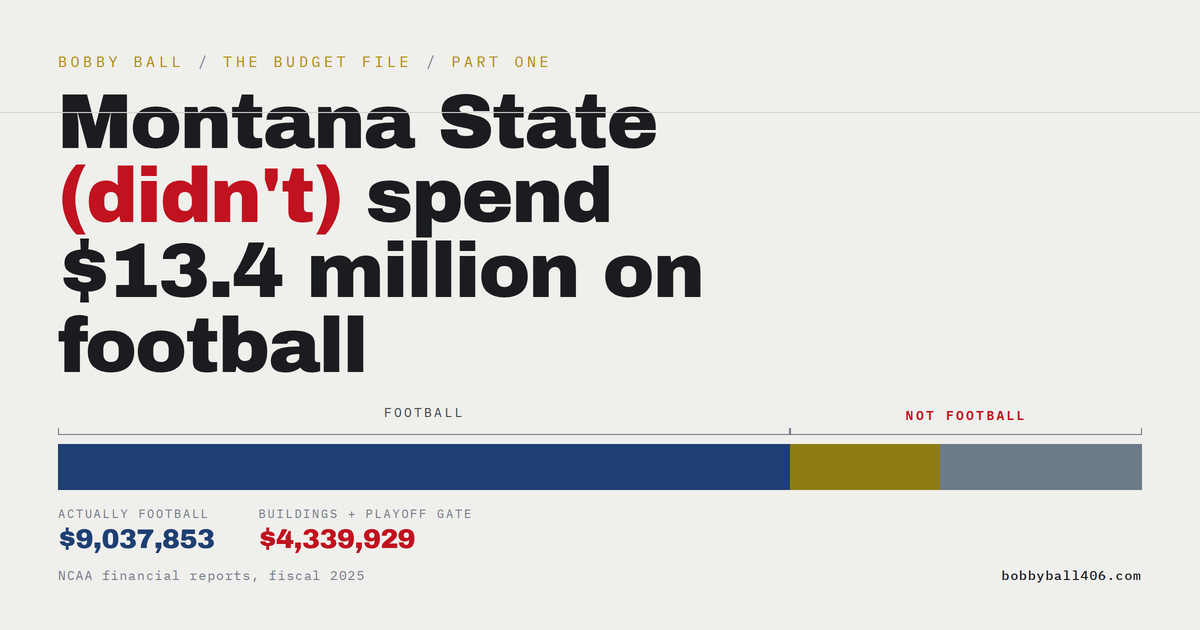
The filing says $13,377,782. The buildings and the playoff gate are $4.3 million of it.

Montana State (didn't) spend $13.4 million on football
As told by Sam Herder, Montana State reported $13,377,782 of football spending last year, the biggest number in FCS, ahead of twenty-some FBS teams. The real 2025 football budget was only about $9 million.
In 2023 MSU reported a football budget of $8.9 million. 2024 was $8.8 million. Then 2025 jumped to the much ballyhooed $13.4 million.
Did their budget really increase $4.5 million? No. It increased about $950,000. Did they do some interesting accounting? Yes.
Subtract out two accounting maneuvers that wipe out the remaining $3.6 million jump, and you are left with the real spend: $9 million.
- The buildings charge rose from $757,439 to $1,853,041, up $1,095,602, in a year the department's own mortgage payment fell.
- A post-season line of $2,486,888 arrived, almost all of it the NCAA's share of a gate Montana State collected and handed over.
One: the buildings
Bozeman charges football for the athletic department's facilities, all of them, $1.8 million, and charges every other sport $0. By contrast, Missoula charges football $6,898 and leaves the rest of the buildings in the shared column, not attributed to any one team. So for an apples to apples comparison, we need to subtract out facilities expenditures, or add in Missoula's. Since the facilities are used by athletes from every team, I chose to subtract. All that to say, MSU's true football spending in 2023 and 2024 was right around $8 million.
$662,428 of that facilities bill is a mortgage payment on buildings every Bobcat team uses. Run that one past your wife. We spent $43,546 on date nights last year, honey. Dinner was $3,546 of it. The rest is the mortgage, and the house is where we watch movies.
Two: the playoffs
The playoff money comes out of both columns too, and not because Bozeman went further in 2024. A playoff host is a ticket window for the NCAA. Fans buy seats, the school holds the cash, the cost of running the games comes out of it, and then the NCAA takes 85 percent of what's left, leaving the host with 15 percent. Almost all of the playoff ticket profits never belong to the school.
Consider Missoula made the same run in 2023. Three home playoff games, then Frisco. The Griz outsold the Cats over those three home games and their ticket revenue moved $294,000. For the same three games, with 12,000 fewer tickets sold, Bozeman claimed theirs moved $2 million. Bozeman also booked $2.5 million of playoff spending, where Montana's entire run cost about $1 million. What is going on?
I'll speculate. First, for these years both played in Frisco, so there is no version of this where a bigger championship venue explains anything. So, what I think happened is Bozeman booked 100% of the home playoff gate through the football ledger and then expensed the NCAA's cut back out. About $1.2 million of that ticket rise came in on three December nights, and $2,486,888 went back out the post-season line. Both sides of the football budget grow, the program finishes roughly where it started, and the spending column looks $2.5 million higher on a gate they kept almost none of. For comparison, Missoula recorded what it kept and nothing else.
In sum: $9 million in actual football spending
When you remove the general athletics buildings, the debt service, and the playoffs, the Cats actually spent $9,037,853 on football. Montana spent $8,669,898 (playoffs removed). So that $4.5 million budget gap I have been reading the Cat fans crow about is actually only $367,955.
Don't just take my word for it, take MSU's, on another form filed with the Feds covering the same period. In it they reported $10.1 million in football spend. After you remove the $1.1 million in departmental building expenses it again counts only toward football (they don't count the mortgage to football this time), we land right back at $9 million.
None of this says Bozeman shorted its football team. On the same books they still spend $367,955 more than Montana does, in scholarships, coaches, meals and travel, which are the right places to spend it. About $950,000 of last year's growth is real football spending. The other $3.6 million came in one door and left by another.
This is my best estimate from what Bozeman has actually released, which is not everything I asked for. Seven records requests are still open, and if the settlement sheets come back and make me wrong, I will run the correction in much, much, much tinier font.
Part 2 of this series will look at how each school funds football. That one is much friendlier to Bozeman. I cannot say the same for Missoula.
Everything above is the complete column. The rest is the arithmetic behind it, and needn't be read by anyone other than those who enjoy accounting prose or those in Bozeman who don't trust this liberal arts grad.
@69gb420 on Xhttps://x.com/69gb420/status/2098820926586736797
@69gb420 on Xhttps://x.com/69gb420/status/2098821783831114029
@celticmoose on Xhttps://x.com/celticmoose/status/2098826081289883832
@69gb420 on Xhttps://x.com/69gb420/status/2098881845329051981
This part is for them.
On the same books, MSU and Montana are $367,955 apart
| Fiscal 2025 football expenses | Montana State | Montana |
|---|---|---|
| As filed | $13,377,782 | $8,889,687 |
| Buildings taken off | $11,524,741 | $8,882,789 |
| Playoffs taken off too | $9,037,853 | $8,669,898 |
It is not four and a half million. The people who spent the summer posting four and a half million were posting a buildings charge and a gross playoff gate.
There is a second opinion, and it just happens to also be Montana State's, on a different form. Every school files a separate report with the U.S. Department of Education covering the same twelve months. Montana's two reports for fiscal 2025 are $233 apart. Bozeman's are $3.2 million apart.
| Bozeman, football expenses | NCAA form | Federal form | Apart |
|---|---|---|---|
| 2022 | $8,431,327 | $8,431,325 | $2 |
| 2023 | $8,947,582 | $8,920,885 | $26,697 |
| 2024 | $8,847,642 | $8,083,850 | $763,792 |
| 2025 | $13,377,782 | $10,135,894 | $3,241,888 |
Kent Haslam is Montana's athletic director. He was asked about these filings on September 11.
@KentHaslam on Xhttps://x.com/KentHaslam/status/2098441457686434064
More than some minor differences on my reading, Kent.
Their two forms used to agree to two dollars. Take the whole playoff line out of the 2025 NCAA number, then take out the same building debt the federal form left out the year before, and you land within $2,439 of the $10.1 million the Cats told the Feds.
Nothing in the federal instructions explains a $3.2 million difference. Missoula filled out both forms and landed within $233 of itself. Bozeman filled out both and landed $3.2 million apart, and that gap is the playoff line plus the building debt. A revenue line and an expense line that cancel each other out the same day are not spending. On the form that asks for actual numbers, the $2.5 million is not there.
And the federal number, $10.1 million, is still not the football budget. It carries about $1.1 million of building charges that belong to every sport in Bozeman, not to football. Take those off and you are back at $9 million, which is right where I started.
Montana made the same run on a total football budget of $8,792,165
December 2023. Montana is the No. 2 seed with a first-round bye, hosts Delaware, Furman and North Dakota State, then plays South Dakota State in Frisco. Same shape of run Montana State made a year later.
Montana's football line for that year: $8,792,165.
Two schools, the same trip, one year apart.
| Montana, 2023 run | Montana State, 2024 run | |
|---|---|---|
| Home playoff attendance | 68,008 | 55,701 |
| Ticket line vs. the year before | +$294,770 | +$2,015,265 |
| Game-day costs vs. the year before | −$71,232 | −$30,981 |
| Buildings charged to football | $0 | $1,848,364 |
| Football surplus vs. the year before | −$534,161 | +$60,582 |
Montana sold 12,307 more playoff tickets than Bozeman did and moved its ticket revenue $294,000. Bozeman moved two million. Game-day costs fell at both schools, because a host pays for those games out of the gate before the money is ever the school's.
Montana's whole football line rose $1.6 million that year. Guarantees paid to visiting teams account for $210,000 of it, and a playoff host pays no guarantees. Coaching accounts for $367,000, and part of that is December. By December 21, with the title game still to play, Hauck had banked $58,500 across eight performance incentives and his assistants and strength coach $12,000 apiece, and the 2024 form had no post-season coaching box to put any of it in. Call the run $1.2 million. Montana State's post-season box, by itself, is $2.5 million, and the post-season coaching money inside it, $70,000, has its own line.
And the surpluses go opposite directions. Going to the title game cost Missoula $534,000. Bozeman came out $61,000 ahead.
One note before anyone else makes it: the form had no playoff box at all until 2025, so Montana's December spending that year is scattered through travel, food and the salary line. Read the $8,792,165, not the zeros.
MSU: A $40,000 loss on one telling, $2.5 million on the other
Last fall, Montana State walked through the run with a reporter. Three home games. Just under 19,000 a night. It kept $190,000. The NCAA sent back $130,700. Frisco cost $360,000. The whole trip lost about $40,000.
The same filing reports $186,600 of playoff money coming in, within $3,400 of what they told the AP, and $2,486,888 going out. A run they publicly called a $40,000 loss.
Montana, for its one home playoff game that year, reported $143,119 in and $212,891 out. Net cost, $69,772. One of those two sets of books matches what the school said out loud.
Bozeman's own form says playoff game-day costs, the officials and the security and the ambulance, belong in the post-season box and not the regular game-day line. That is why the regular line fell in a year they hosted three extra dates.
So price it. Three playoff dates at what Bozeman charges itself for a regular Saturday is about $111,000. Frisco was $360,000 by their own telling. Throw in the entire department's band and spirit budget, $76,475, though football's column lists none of it. Be generous everywhere and you land at $548,000.
The post-season box reads $2.4 million.
The AP numbers are rounded and I would not hold them to the dollar. But a trip that roughly broke even does not leave $2.5 million sitting on the spending side against $186,600 coming back. I have asked for the NCAA's settlement sheets on those three home games and for what is actually in that box.
MSU's ticket line rose $2 million, and $1.2 million of it was never MSU's
Bobcat football tickets: $3.65 million in fiscal 2024, $5.66 million in fiscal 2025. Up $2,015,265.
Fiscal 2024 is the clean year to compare. Five home dates, 107,645 fans, $33.90 a seat. Fiscal 2025 added a sixth date and 23,747 more regular-season fans, worth about $805,000 at that rate.
The rest, about $1.2 million, walked in on three December nights. Across 55,701 playoff seats that is $21.73 a ticket, which is what an FCS playoff ticket costs. It is an estimate, built off their own gate and their own announced crowds, and the settlement sheets would replace it with a receipt.
Here is the part Bozeman will not enjoy. Those three playoff crowds averaged 18,567. The regular season averaged 21,899. The semifinal against South Dakota drew 20,557. Mercyhurst in September drew 21,547. They drew better for Mercyhurst than for a national semifinal.
Montana took $6.2 million from 180,912 regular-season fans, $34.38 a head, more money from more people in a bigger building.
MSU football gets the buildings, tough luck volleyball
This is the whole athletic department's building bill, not the stadium's. Debt, leases, rent, on every facility the Bobcats use. Bozeman put all $1.85 million of it on football in fiscal 2025, and has put at least 93 percent of it on football every year on file. Last year it was all $757,439. Men's basketball, women's basketball, volleyball, skiing, track, tennis, golf: $0, five years running.
I hate to break it to the Cats' other teams, but you have been evicted by your own athletic department. There is a YMCA in Bozeman.
Missoula runs the opposite. Not one dollar of the debt and leases goes on football. The $1.14 million sits in the shared column, because the buildings are shared. Add up every building and overhead line and Montana charges football three-tenths of one percent of it, for a program that is 29 percent of the department's spending. Bozeman charges football 72 percent.
Both ways of splitting the bill are legal. Only one of them puts the volleyball team's roof on the football team's tab, and only one of them produces a football budget that leads a national ranking.
Last year the football building charge and the department's actual mortgage payment were the same number, $757,439, to the dollar. This year the mortgage fell, to $662,428, and the charge to football rose to $1,848,364. The extra $1.19 million is leases, rent, or an internal loan. The report does not say which.
It does say when. Fiscal 2025 opens on July 1, 2024. Montana State broke ground on its new indoor athletic center on July 16, a donor-financed building that its own announcement says will serve football, men's track, women's track and community athletic groups on specified evenings and weekends. Athletics debt rose $5.6 million that year. The building is shared four ways. The bill only went to one.